Key takeaways
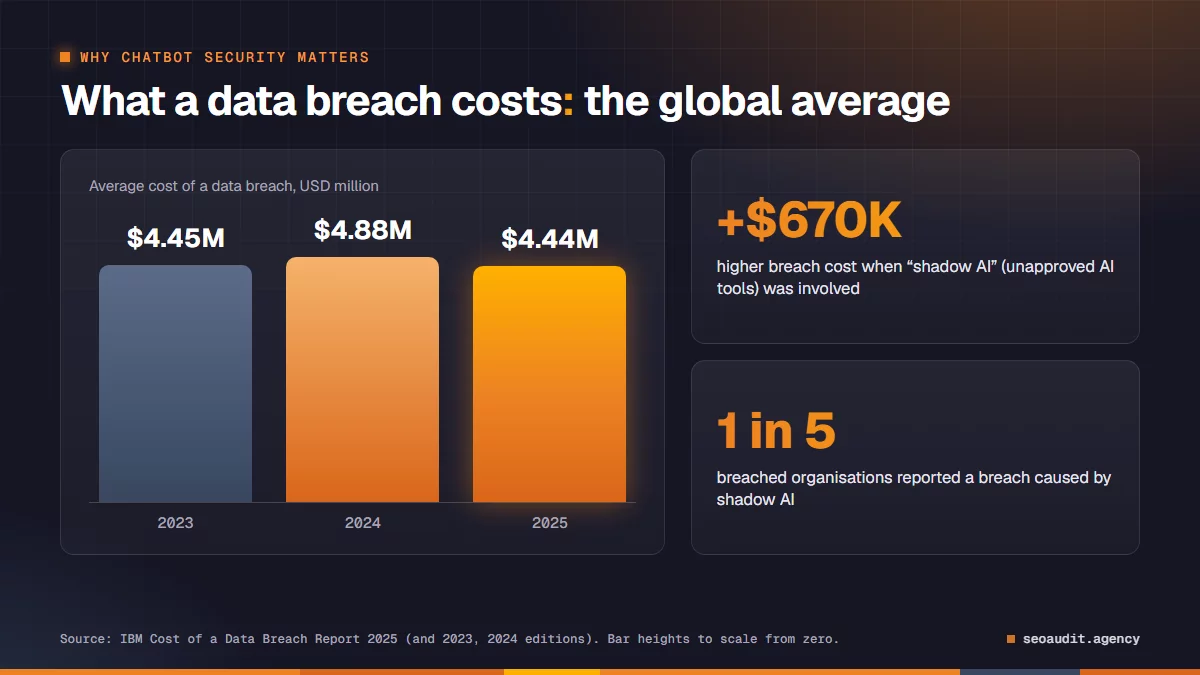
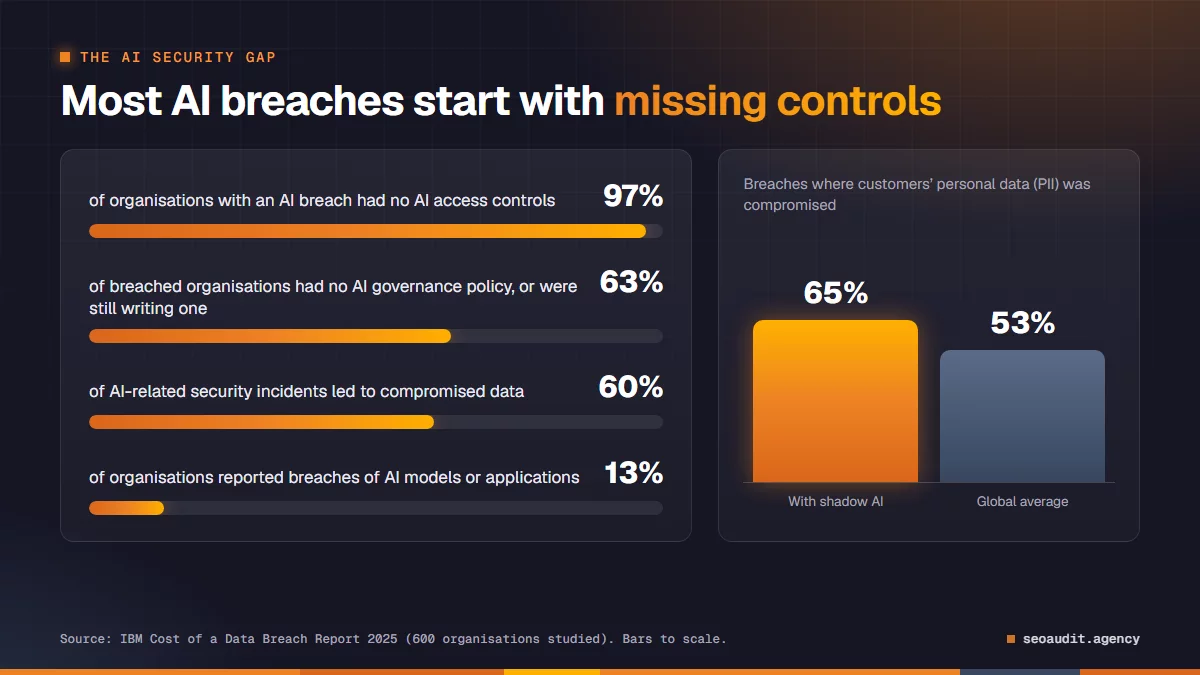
- A data breach costs $4.44 million on average (IBM, 2025), and 97% of organisations with an AI breach lacked AI access controls.
- Map what data the chatbot will see before you choose a tool.
- Remove personal details before any text reaches an AI provider, and get “no training on your data” in writing.
- Connect your systems read-only, with only the fields an answer needs.
- Lock sensitive topics so they always go to a person, and guard against prompt injection.
- Bangladesh now has a data protection law: plan for consent, retention and deletion from day one.
An AI chatbot is safe for business use when it keeps personal data away from the AI model, reads your systems only through limited read-only connections, answers only from approved content and hands sensitive topics to people. The 12-point checklist below turns those rules into questions you can put to any vendor, ours included.
It is written for business owners and managers in Bangladesh, especially in eCommerce, banking, healthcare, education and government services, where a single leaked conversation can cost customer trust.
Why chatbot privacy is different from a normal website form
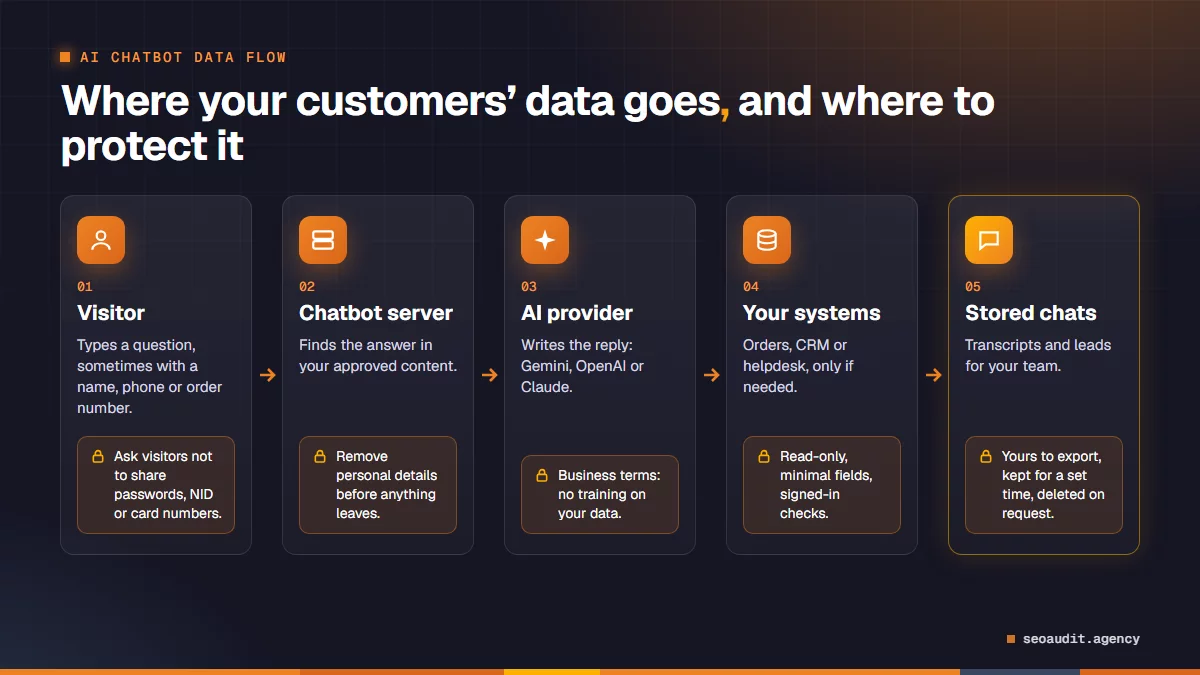
A contact form asks for exactly the fields you choose. A chatbot accepts free text, so customers often share more than you asked for: a phone number, an order ID, a health detail or even a national ID number in the middle of a question. That data then travels through several systems before a reply comes back.
AI chatbots also bring new kinds of risk. The OWASP Top 10 for Large Language Model applications ranks prompt injection (tricking the chatbot with crafted instructions) as the number one risk and sensitive information disclosure as number two. Both are design problems you can reduce, not reasons to avoid chatbots.
The cost of getting it wrong is real. IBM’s Cost of a Data Breach Report 2025 puts the global average cost of a breach at $4.44 million. One in five breached organisations reported a breach caused by “shadow AI” (AI tools used without approval), which added about $670,000 to the average cost.
The same study shows that most AI breaches start with missing basics: 97% of organisations that reported a breach of an AI model or application had no proper AI access controls, and 63% of breached organisations had no AI governance policy or were still writing one. That is exactly what the checklist below fixes.
The 12-point AI chatbot privacy and security checklist
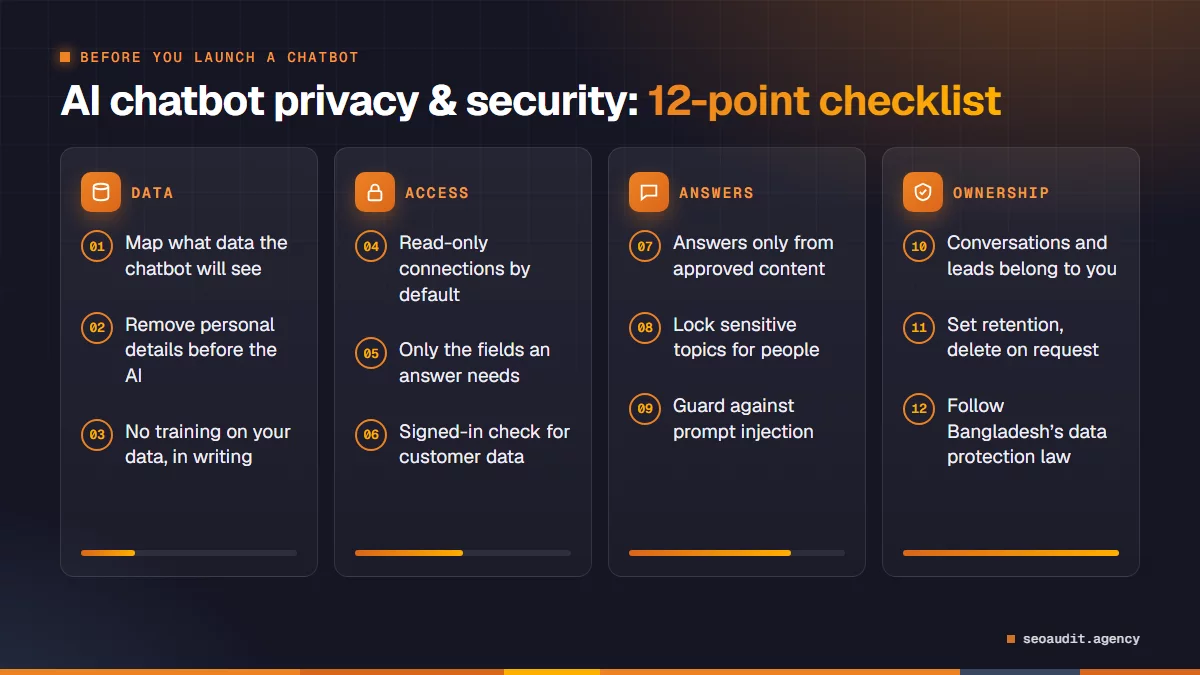
Group the checks into four areas: data, access, answers and ownership. A good vendor can answer each one clearly and in writing.
Data
- Map what data the chatbot will see. Public FAQs only, or orders, accounts and internal documents? The answer decides how strict every other control must be.
- Remove personal details before the AI. Names, phone numbers, emails and account numbers should be masked before text is sent to the AI model.
- No training on your data, in writing. Use the AI provider’s business terms. For example, OpenAI’s data guide for its API says business data is not used for training unless you opt in, and abuse-monitoring logs are kept for up to 30 days by default. Other providers publish similar business terms: read the current version before you sign.
Access
- Read-only connections by default. The chatbot should look things up, not change them, unless an action such as creating a ticket is agreed in writing.
- Only the fields an answer needs. Order status, not the whole customer record. Never share a database password.
- A signed-in check for customer data. Each customer must see only their own orders or account details.
Answers
- Answers only from approved content. The chatbot should answer from your website and documents, show its source, and say “I don’t know” instead of guessing.
- Lock sensitive topics for people. Refunds, complaints, medical, legal and financial questions should go to a person every time.
- Guard against prompt injection. Ask how the vendor stops a visitor, or a web page the chatbot reads, from overriding its instructions, and what the chatbot is never allowed to reveal.
Ownership
- Conversations and leads belong to you. The contract should say so, and you should be able to export them at any time.
- A set retention period and deletion on request. Know how long transcripts are kept and how a customer’s data is deleted when they ask.
- Follow Bangladesh’s data protection law. Consent, purpose and cross-border transfer now matter in law, not just in good practice (see below).
Questions to ask any chatbot vendor
Use this table in your next demo. A vague answer to any row is a reason to slow down.
| Ask the vendor | Good answer | Red flag |
|---|---|---|
| What happens to personal details in a chat? | Masked before the AI model sees them | Sent to the AI as typed |
| Is our data used to train AI models? | No, written in the contract | “Not usually” or no written answer |
| Which AI provider do you use? | Named, with its business terms | Cannot say |
| How do you connect to our systems? | Read-only API, minimal fields | Asks for a database password |
| Where do answers come from? | Only our approved content, with sources | General internet knowledge |
| What topics go to a person? | Any topic we lock | The bot answers everything |
| How is prompt injection handled? | Clear limits and tests explained | “That can’t happen” |
| Who owns conversations and leads? | We do, exportable and deletable | Unclear or vendor-owned |
| How long are chats kept? | A set period we can change | Kept forever by default |
| Will you tell us about a breach? | Yes, with a stated timeframe | No process |
What Bangladesh’s data protection law means for chatbots
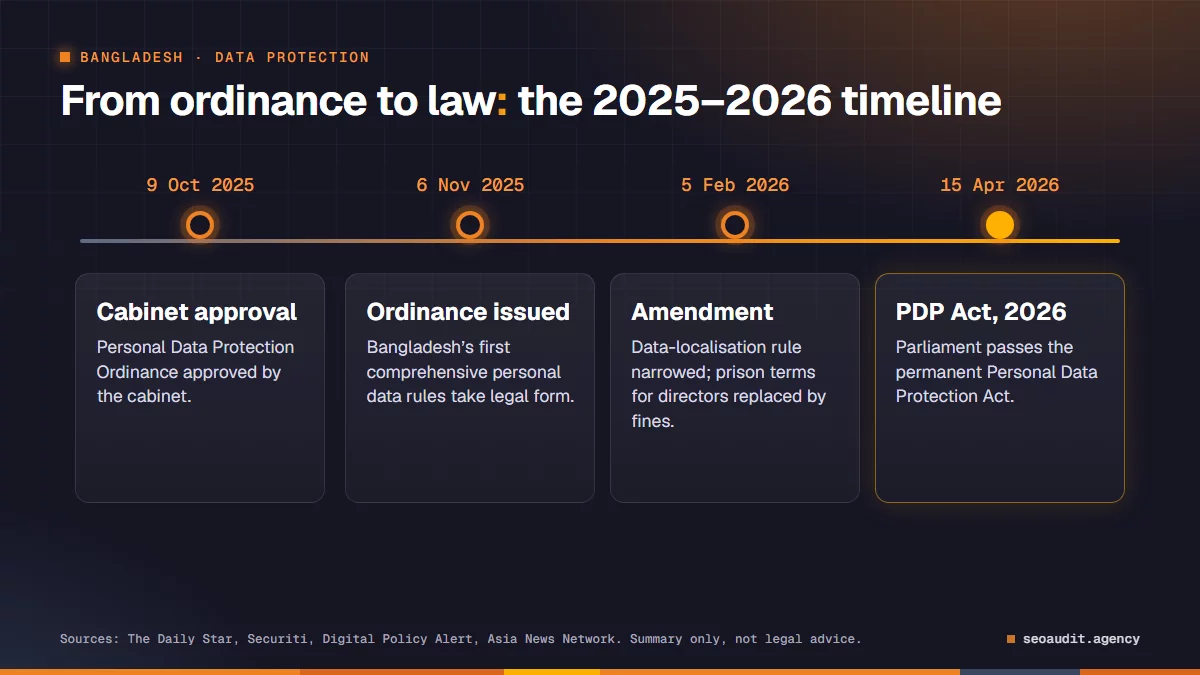
Bangladesh now has its first comprehensive data protection law. The Personal Data Protection Ordinance was issued in November 2025, amended in February 2026, and replaced by the Personal Data Protection Act, 2026, which Parliament passed in April 2026 (overview by Securiti). The February 2026 amendment narrowed the earlier data-localisation rule (Digital Policy Alert).
For a chatbot, the practical points are:
- Consent and purpose: tell visitors what the chat collects and why, and collect only what you need.
- Cross-border transfer: most AI providers process data outside Bangladesh, so know where your data goes and what the law requires for it.
- Sensitive data: health, financial and similar data need extra care. Lock those topics or keep them away from the AI.
- Access and deletion: be ready to show or delete a person’s data when they ask.
This is a summary, not legal advice. Rules and deadlines can change, so confirm your obligations with a lawyer, especially in banking, healthcare and telecoms.
Hosting options for regulated businesses
Most businesses are well served by a reputable cloud platform with business terms. Banks, hospitals and organisations with strict policies may need more control:
- Managed cloud: fastest to launch, good for public FAQs, product and order questions.
- Dedicated setup: your own environment and stricter data rules for sensitive workflows.
- Private or on-premise AI: the model runs on your own servers so data never leaves. See private AI deployment in Bangladesh.
Decide early, because it affects the design. If you need integrations, read how to connect an AI chatbot to your CRM safely.
From our work
The question clients ask us most before they choose a chatbot is simple: “Will my customers’ data go to the AI company?” Every point in this checklist is there to help you answer that question clearly, and in writing.
Common questions
Is it safe to use ChatGPT or Gemini in a business chatbot?
It can be, if personal details are removed before text reaches the model, the chatbot answers only from your content, and you use the provider’s business terms, which exclude your data from model training.
Do AI chatbots store my customers’ conversations?
Most do, so your team can review chats and follow up on leads. Ask how long transcripts are kept, who can see them, and how they are deleted on request.
Can a chatbot see other customers’ orders?
It must not. A signed-in check and per-customer limits ensure each person sees only their own records.
Should a chatbot ever have write access to my systems?
Only for specific, agreed actions such as creating a booking or a ticket, tested on a copy first. Everything else should be read-only.
Who owns the chatbot conversations?
You should. Make sure the contract says your data, conversations and leads belong to you, can be exported and are deleted on request.
Do I need customer consent for a chatbot in Bangladesh?
Under the Personal Data Protection Act, 2026 you should tell people what personal data you collect and why, and collect only what you need. Ask a lawyer how consent applies to your exact use, especially for sensitive data.
The bottom line
Privacy and security decide how a chatbot is built, not something to add later. Map the data, keep personal details away from the AI, keep system access read-only and minimal, lock sensitive topics, and make ownership and deletion clear in writing. Do that, and a chatbot can safely answer your customers day and night.
New to the topic? Start with what an AI chatbot is or our complete guide to AI chatbots for Bangladeshi businesses. Planning a chatbot for a regulated business? See custom AI chatbot development.
Written by
Maqsood Rahman
Founder of SEO Agency Inc. 25 years in search: 17 in New York and, since 2018, in Dhaka. Leads strategy on every client account.
Keep reading